During a team training session with a large healthcare company, it became evident that two women on the team needed to work better together. It started with the body language, then the eye contact, and ultimately with how each of them reacted to the information that was shared. Then, as sometimes happens, Woman A looked over at Woman B and blurted out, “I thought you never got anything done. Your desk is always a mess.” Woman B hesitated and took in the comment gracefully.

After a pin-drop moment, she started to smile slightly, with a twinkle in her eye. She made direct eye contact with Woman A and said, “I thought you never got anything done. Your desk has nothing on it!” The whole room broke out in uncontrolled laughter. Once the laughter calmed down, there was a sustained moment of total silence. Woman B got up, walked over to Woman A, put her arm around her shoulder, and said, “Maybe there’s something here we can learn from each other.”
Learning Accelerates Personal and Professional Growth
By observing, analyzing, and recognizing others’ strategies, you can gain valuable insights that help you achieve your goals more consistently. You might even be able to take on one or two of their techniques as your own. You won’t instinctively approach the problem in their way, but you can see how their approach could be helpful and give you an advantage. Over time, you learn, practice, and make these insights permanent.

Or, you might determine that the work is too hard and won’t be sustainable anyway. In that case, the best alternative may be to partner or team with a person for whom these instincts come naturally. By no means does this mean you can’t learn the skill through deliberate practice. It means you completely value their approach and recognize that this talent is a must-have for your team.
I see that people fall into five categories as we work and interact with each other: Refreshers, Reflectors, Refiners, Reducers, and Rejecters.*
Refreshers encourage us.
Reflectors mirror us.
Refiners improve us.
Reducers diminish us.
Rejecters devalue us.
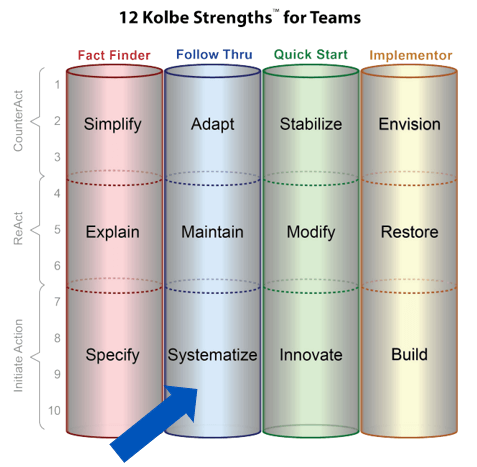
It’s great to have Refreshers and Reflectors around, but I am always looking for those who might Refine me. In the Kolbe System™, I am a two in Follow Thru, so Refiners for me would be people on the other end of the Follow Thru continuum.
Follow Thru
Follow Thru is the instinctive need to pattern and the way we organize and design. When people operate at the 7–10 level, it leads to actions where an individual will organize, systematize, create a sense of order, structure, plan, coordinate, arrange, schedule, and complete. This means that instinctively they will use their time and energy to address problems through these methods.
Follow Thrus are invaluable as team members for their efficiency, completeness, and systems for comprehensive plans. This energy needs a place for things to reside.
Meet Jessica
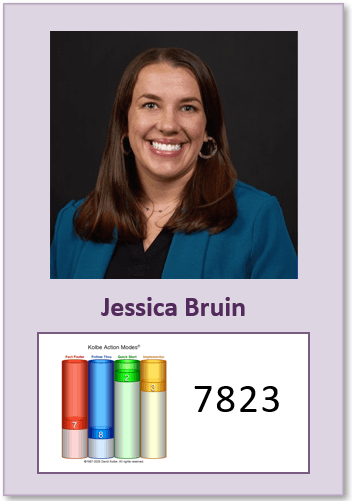
Let’s meet Jessica Bruin from Mars Snacking. She is a newly appointed Director of Activity Management of Salty Snacks with a 7823 Kolbe A™ Index result. “It was an ‘Aha’ moment when I got my Kolbe results. The language said, ‘I Systematize.’ This is what makes me tick. I love it when my colleagues value my systematizing. It is a key strength as I continue to manage projects and manage people. My thoughts need a place to live. There is a place for everything.
At home, I have a label maker and there are labels everywhere. For example, my spices are labeled. They are taken out of their original container and put into a new uniform container, labeled, and alphabetized. The need is for them to be uniform and fit where they go. At work, I have become known and loved for my “Master Files” for each of my projects.
This is an Excel file where all cross-functional team members can find the latest information on project timelines, sample information, and data about the new products we’re bringing to consumers. I create a central location for the latest team meeting notes and additional content.”
Jessica gets to work on the Pringles brand as they introduce new flavors. She has worked hard to insert herself at the front end of projects with Marketing. “I love seeing my projects brought to life on a store shelf that I get to share with family and friends. I want to be perceived not as a naysayer, but as a practical, close partner and ally. When building a project timeline, I start with the date needed to ship the new product, then work backwards. It’s really exciting when my preparation is valued, appreciated and noticed by team members who say, ‘that was a really good plan.’”
I also admire Ellen Beidler, Human Resources Manager for Nederveld. Nederveld is a trusted provider for land surveying, civil engineering, landscape architecture, forensic services and related technical consulting for property owners, developers, and construction projects across the United States. Ellen’s Kolbe A™ Index result is 7922. “Kolbe was an epiphany of self-awareness for me. It succinctly identified why I was feeling frustrated with tasks where there was uncertainty. Now, I can advocate for myself by asking questions to get clarity. When there is ambiguity on the end goal I must create a framework for order. I need to start with the end goal and then work backward to create the framework. Framework, sequence, structure—all those words resonate with me.”
Meet Ellen
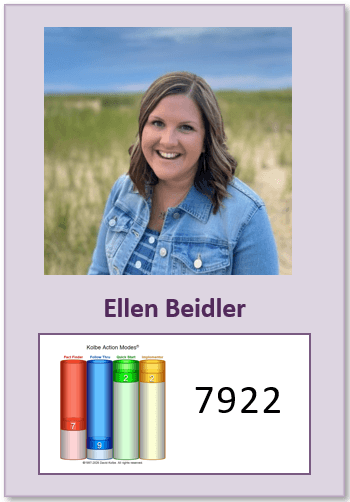
In Human Resources, Ellen leads five people in their work with employee relations, policies, compliance, and HR processes. Ellen’s need for clear, repeatable systems and predictable organization aligns well with this work that requires consistency, attention to detail, and dependable execution. Ellen also has a need to bring closure to tasks: “I find it stressful when new projects pile up before existing ones are finished or have progress made.”
Ellen’s striving instincts are also evident in how she operates at home. “I can manage chaos throughout the day, but before going to bed I must do a reset. The end goal is cleanliness, so things need to be put away and wiped down. Things need to go back to their home—their spot.” With a clear place and a sense of completion, “I experience calm with this structure.”
The Consistencies
What is consistent with both Ellen and Jessica? They can both deal with chaos throughout the day, but their role is to create order out of the chaos. They provide a (1) place for efficiency, (2) contribute to creating the plan, sequence and framework, and (3) bring initiatives to closure. They both have an innate talent to track and monitor activities and events to keep projects and people on time and on formula. Ellen creates a reset. Jessica focuses on a uniform, labeled, central location approach.
How can we cultivate an attitude that is ready to learn from others, from an Ellen or a Jessica on your team? Often, it gets triggered by, “my life is out of control.” It comes out of desperation. Even though chaos may bring joy, we find our lives are unmanageable in the present. Life’s circumstances have forced us into a ready-to-learn stance. The great saying does hold true: “When the student is ready, the teacher will arrive.”
Ways you can learn:
First, by saying, “I’ve never seen it that way before, but now I see a need for that.” You are opening yourself up to how this methodology might improve your life. Be positive, open, and have a curious and active stance toward new learning.
Second, by recognizing what you want to accomplish. Is it a near-term, medium-term, or long-term goal? “What exactly do I want to improve? What do I want to be different?”
Third, watch and try. We can all learn from others: peers, mentors, those we manage, and those who manage us. Notice the patterns, strategies, and habits that others use. Ask questions, and then more questions. “Could you show me how to do it that way? What’s your reason for that?”
Fourth, start speaking the language. Plan, map, formula, playbook. “What course should we take? Where does this go? What’s the appropriate sequence we will need? What’s the end goal? What’s it going to take to cross the finish line with that project?”
Fifth, adapt the strategy and practice routinely. Don’t try to adopt or copy it verbatim. Adapt what you have learned to a practice that you can make sustainable. Practice makes permanent.
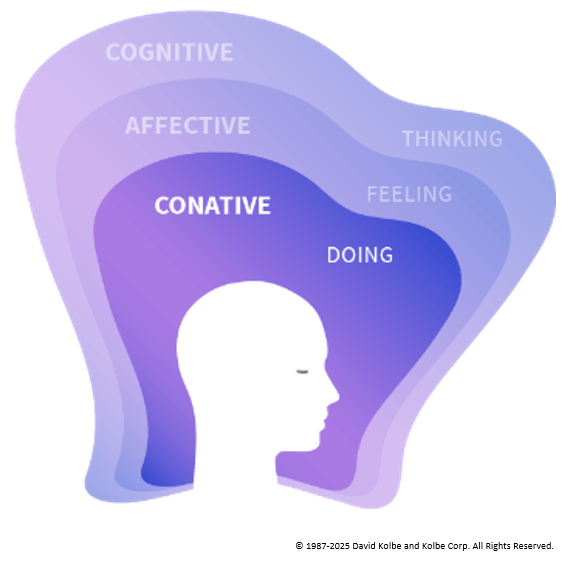
Using the 3 Parts of Your Mind
By using all three parts of your mind, you have:
Cognitive openness – believing others can offer valuable insights.
Affective readiness – feeling curious and comfortable with new perspectives.
Conative engagement – actively asking questions, observing, and putting into practice what you have learned.
Instead of reinventing the wheel, you can leverage the experiences and knowledge of those who have already succeeded. Remember to customize your approach and stay true to your own instincts.
I may not be able to go as far as actually creating the structure, but when I see something valuable that someone else has created, with a bit of effort, adaptation to my own method, and diligent practice, I can follow it, support it, and add it to my arsenal. Instinctive strengths are the raw material; skills are the craftsmanship built from that material through deliberate practice.
What I have learned from those who Systematize in Follow Thru over 36 years:
- Have a place, make a place, even if it is out in the open. You will be more efficient in locating what you need. For example, adding a jewelry tree on my bureau has prompted me to wear more of the jewelry I own rather than let it languish in a drawer.
- Keep working on the best time-management and To Do list approach you can. I need two systems – one for small, immediate short-term tasks (today) and the other for longer-term and larger initiatives that require more thinking and creative work. They both include clear end goals and a personal commitment for finalizing. Land on something that works for you to keep your responsibilities front and center so you can see both progress and closure.
- Don’t see each step as drudgery, but as essential rungs for achieving your goals.
- See value in using your time to plan, consolidate, and organize, not once in a while or when clutter has become overwhelming, but frequently. Create a habit—do a reset!
The most effective training is done as a team. This is the atmosphere where all team members can learn, discover and apply the shared principles. It is the unique discovery each person makes that propels the learning into real sustained performance. At PSG our niche is to accelerate the communication, collaboration and teambuilding process. We are here to help you master the art of working together.