
Over the past weeks, we have witnessed a powerful definition of reliance when teams truly work together. Olympic athletes demonstrate this valuable principle each time they compete on the world stage.
Congratulations and thank you to these world-class performers for showing us what unwavering desire looks like when combined with elite skill, competence, commitment, dedication, maturity, and discipline. No matter the sport, Olympians are an inspiration.
I won’t hide it. I have been captivated by the curling events.

I grew up in a Wisconsin town with a Curling Club. Today, Holland, MI has its own ice ribbon and curling sheet. Curling is a precision-based team sport played on ice, where players slide granite stones toward a target area called the “house.” The Scots invented curling in the 1500s. Of course they did. They also invented golf. My theory is that women in Scotland wanted the men out of the house in both summer and winter alike!
The Strategy of Curling
What fascinates me is the strategy. Curling is a three-dimensional game of chess. Add a billiards mindset, then combine it with the unpredictable nature of an ice sheet that seems to have a mind of its own. I find it enthralling. Others compare it to watching paint dry. Each game lasts about three hours.

I cheered and even teared up for Cory Thiesse and Kory Dropkin, the mixed doubles pair who brought home the Silver Medal for the USA. With that medal, Cory Thiesse stands apart as the only U.S. female athlete ever to medal in Olympic curling. Dropkin first invited her out for a drink. It was not for a date, but to ask her to join his team. Later, she received another call. “I got goosebumps when I received the call from Tabitha Peterson,” she shared. Peterson is the women’s team skip, or captain.
Those invitations send a powerful message: We can rely on you.
The Pinnacle of Team Performance
Reliance is the pinnacle of team performance. Isn’t that what we are all striving for?
In my Seven Stages Model for Team Performance, teams move through the Foundational Stages, then the Catalytic Stage of Trust, followed by the Performance Stages. At the very top sits Reliance.
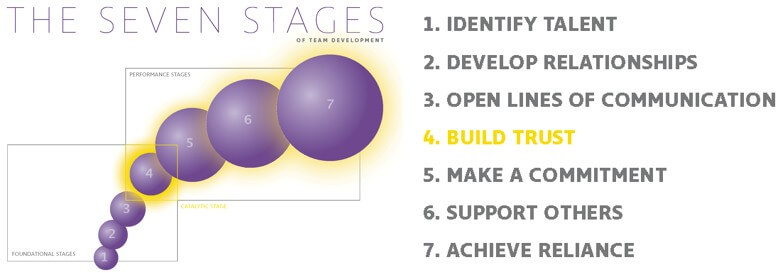
At this highest stage, team members rely on one another—even though reliance requires vulnerability—to achieve true team results. Reliance recognizes that no one maximizes his or her talents in isolation.
Curling is a Game of Reliance
In curling, team members take turns throwing a 40-pound granite stone down the ice toward the target. Once released, the thrower must fully rely on two teammates who sweep the ice to guide the stone’s speed and direction. Sweeping smooths the surface, helping the rock travel farther or adjust slightly left or right to reach the intended spot.
Most often, this is done to remove an opponent’s stone from the scoring circle. Without the sweepers, the stone can fall short or drift off course, disrupting the entire strategy for that turn. The thrower is vulnerable to the skill of these other team members. Every throw requires reliance.
As author and leadership icon Max DePree said, “We need to be vulnerable to the strengths of others. We need to allow others to do that which we cannot do.”
So how do we define reliance? It is a healthy mixture of:
- Ownership
- Accountability
- Dependability
- Trust
- Confidence
- Belief
- Dedication
Team members are eager to prove their value. Put me in, Coach. I’ve got this. You can count on me.
What It Takes to Reach Reliance
Achieving reliance requires consistency. All team members must consistently fulfill responsibilities, meet deadlines, take ownership, and perform their roles without constant supervision. Dependability becomes a core value. When this happens, leaders spend more time on strategic growth rather than micromanaging. Constraints and bottlenecks are eliminated. Morale improves. High-quality results and operational excellence become the norm.
What Gets in the Way?
Why don’t teams reach reliance? What stands in the way?
- Lack of desire or motivation
- Poor job fit
- Insufficient knowledge or competence
- No commitment to the goal, plan, or timeframe
- Lack of maturity
- Lack of discipline
Questions to Ask Yourself
- Are you someone others can rely on?
- If you hesitate, what is getting in the way?
- What will you do next?
Cory Thiesse got the call.
What do you need to change to get called up for that once-in-a-lifetime assignment?

Our Mission at PSG
Our mission at PSG is to give your teams a competitive advantage simply because you know more. We begin by helping team members understand their strengths and talents. We then explore the differences that surface to minimize conflict so healthy relationships can develop.
Teams develop a shared language—one that teaches each member how to communicate effectively with others for seamless handoffs. Trust is built. We move from the Foundational Stages through the catalytic effort of building trust and into the Performance Stages. Commitment aligns everyone around a shared purpose. As each member understands both their sweet spots and blind spots, supporting one another becomes natural. Teams stop working around each other and start relying on each other.
When reliance takes hold, excellence becomes sustainable.
Reach out if you’d like to learn more about what PSG can do for you or your team.