
“If a man does not master his circumstances, then he is bound to be mastered by them.”
I recently finished reading A Gentleman in Moscow by Amor Towles—a truly humorous and insightful novel. The story follows a wealthy Russian count who, in 1922, is sentenced to house arrest inside the Metropol, an extravagant hotel in Moscow.
This sentence strips him of his freedom, his ability to come and go as he pleases, and confines him within those four walls for decades.

For most of us, such circumstances would provoke an enormous amount of anxiety. Yet the count responds very differently. Throughout much of the book, he admirably masters his circumstances—so much so that one friend refers to him as “the luckiest man in Russia.”
Many of Us Are Feeling Anxious
Anxiety, it seems, is the emotion of the day. Many news headlines are designed to provoke fear, confusion, and a sense of impending dread. As a result, more and more of us are feeling anxious.
When anxiety takes hold, it often manifests physically as muscle tension, fatigue, headaches, digestive issues, and sleep disturbances.
In the short term, anxiety increases our breathing and heart rate, directing blood flow to the brain where it’s needed most. This physical response prepares us to face an intense situation.

However, when anxiety becomes excessive, we may feel lightheaded or nauseous, and some people experience high blood pressure and chest pain. Persistent anxiety can have a devastating impact on both physical and mental health, eventually contributing to chronic conditions.
Yet anxiety itself isn’t the villain. Karla McLaren, in her book Embracing Anxiety, describes anxiety as the emotion of motivation. She writes, “The feeling of anxiety is the emotion of motivation which actually helps us to gather our resources, plan, schedule, complete tasks, and meet deadlines.” It isn’t the feeling of anxiety that harms us—it’s the long-term, unmanaged impact on our bodies. If we can learn the language of this emotion and master it, we can change our lives.
So where do we begin?
As Socrates advised, “Know thyself.” We start by taking inventory—of ourselves and how we personally relate to anxiety.
My dear friend Rob Pasick writes in Self-Aware: A Guide for Success in Work and Life, “Sages throughout history and across cultures have urged us to be self-aware, and thereby understand our world. Modern psychological sciences have consistently reinforced the idea that well-being begins with self-awareness.”
You’ve heard me say it before: the power is in the knowing. Mastery comes through awareness put into action—repeatedly. To master something is to learn to control an emotion or a response. It means achieving victory over it. It also means learning something deeply and well. As with an athlete or a musician, mastery only develops through consistent and dedicated effort.
The next question becomes:
What do we want to master?
I’ll start with myself. My role requires a significant amount of documenting, writing, researching, and analysis. The energy for this work comes through my Fact Finder instinct. My natural energy level here is moderate—a 4 on a scale of 1–10.
This means I’m most effective when explaining something rather than researching it. When deep research is required, my body’s natural response is procrastination; I simply don’t have abundant energy in that area.
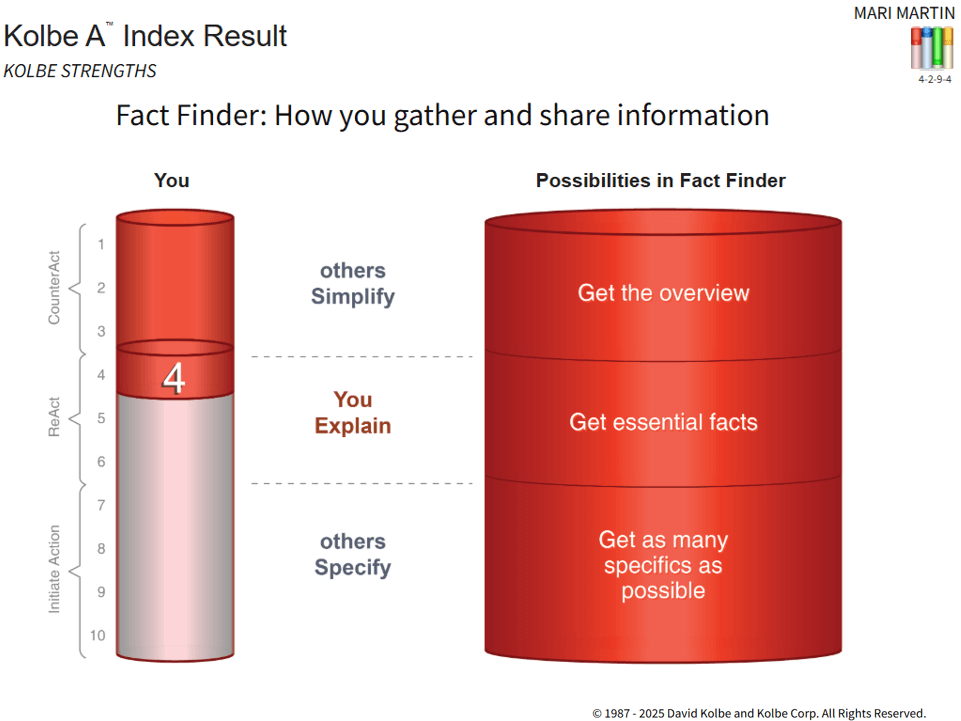
With awareness, however, everything changes. I now recognize that research-heavy tasks create anxiety for me. And this is the turning point—for all of us. The question becomes: What will I do about it?
Mari’s Model
Here’s a simple model I’ve developed:
When we have little knowledge and little energy, we are groaning.
When we have energy but limited knowledge, we are getting by.
When we commit to learning and building knowledge, we are growing.
And when we have both knowledge and energy, we are going strong.
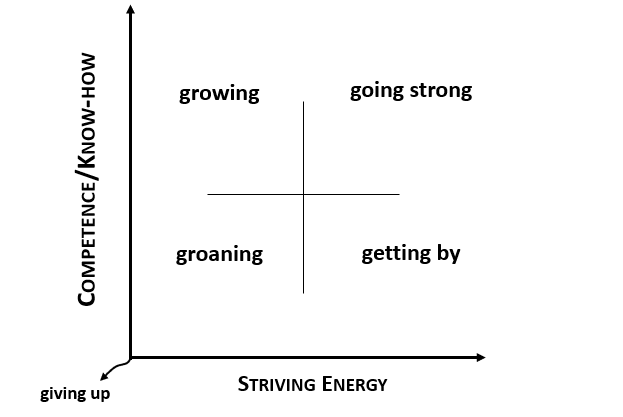
There is, frankly, a level even lower than groaning—and that is giving up. Along the journey from giving up to going strong, we learn, grow, and make better choices. We move beyond merely coping with life to actively managing and mastering our circumstances.
This is why knowing your Kolbe A™ Index—and understanding it deeply—is so powerful. Kolbe describes the verbs about you and it’s in the verbs that work and life happen. When you apply it intentionally across your work and your life, it places the power of decision-making squarely in your hands. Anxiety subsides because you are now in control, instead of “it” controlling you. This simple awareness can transform anxiety into well-being.
“Well”
I have long loved the word well. It is certainly one of the more versatile words in the English language—
- In a good or satisfactory manner: our plans are going well
- Thoroughly, carefully, soundly: the problem is well understood
- In a moral or proper manner: to behave well
- Commendably, meritoriously, or excellently: a difficult task well handled
- With favor or approval: to think well of someone
- Comfortably or prosperously: to live well
- With great or intimate knowledge: to know a person well
- With good nature; without rancor: he took the joke well
- Come up as a liquid: tears welled in her eyes
- In good health; sound in body and mind: I feel well
- Well-being, good fortune, success: to wish well to someone
- Wise or advantageous: it would be well to start early
- Used to express a range of emotions, including
surprise, anger, resignation, or relief: Well, really, she had the audacity to say that! - A spring, natural source or abundant source: she was a well of information
- A deep place in the earth where water, oil, gas, or brine can be pulled up from: they dug a well
I know many of you so well that, quite honestly, tears well in my eyes as I think about your wellness. My wish is that each of you will master your circumstances well. Most importantly, I wish you good health—soundness in body and mind—and a life full of well-being. I hope these reflections serve as a well of information that helps you live well and be well.
Well—on to 2026, as you focus on what you want to master well.
Power Up Your Productivity
Some people are able to master a skill or an emotion on their own. Even so, we know that the most accomplished individuals—athletes, leaders, and artists alike—seek out coaches and mentors to guide, challenge, and equip them along their journey to mastery.
Our coaching approach, called Power Up Your Productivity, addresses mastering the demands of your work and relationships, reducing anxiety and minimizing stress. You can expect new insights, clarity, and intentional action.
Mastery begins with knowing yourself. And well-being follows.